

That BAFTAs thing.
Another poorly framed argument.

I didn’t watch the BAFTAs - I used to enjoy stuff like that, but now I find it dull and pointless, great if you’re actually there - but I never get invited, and I can scan the results in the morning.
Obviously - I’ve read quite a bit about the ‘drama’. I’ve seen quite a few viewpoints - but somehow they all seem to miss the point - or at least want to dodge the real issue and look for the crutch of outrage or offence.
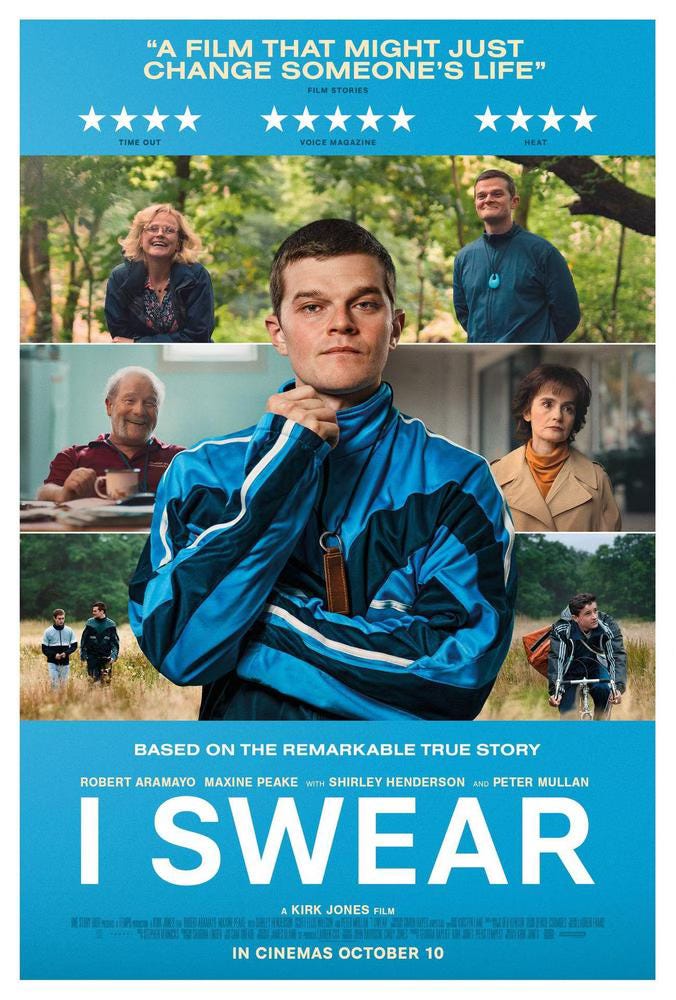
I Swear, which is apparently very good, but I have not seen it yet - probably because I would find it very stressful and I’m not in the right place for that one, right now.
First - a tiny bit of context. I don’t know anyone with Tourettes, per se - I know a couple of people at a distance and have had a couple of close encounters. When I lived in Liverpool, a local lad in his mid 20’s had tourettes. He would shop occasionally in the Tesco near my house in Aigburth. The staff were all middle-aged local women who knew each other (it was like the mafia in sensible shoes). When this lad came in, they ALL knew instantly - like some kind of hive mind, and everyone tensed. This lad would do his shopping, accompanied by loud tics and grunts (most sounded like he was trying to hold in a sneeze). He was young and good-looking but very tense and hunched, like he was trying to hold himself together in a tight knot of self-control. He would do his shopping, the store would be silent, and nobody would make eye contact with him.
Once, as he left, I overheard one of the staff say, “He’s just making it up for attention”. He never swore or said anything coherent or offensive - just tics and grunts. That poor kid. You could see the wall he’d built about himself.
Locally, there is a volunteer in the Oxfam shop who also has Tourette’s. He’s a pleasant, well-spoken, very friendly middle-aged man who goes out of his way to be nice to everyone. In his case, his tick is to repeat the words Yes, Yes, Yes, No, bisquits, milk, breakfast’ randomly throughout the day on repeat. Nobody says anything - he’s totally inoffensive, although I assume some people snigger (he is the least weird person working there by far). There is nothing he can do about it.
A few years ago, a journalist had the concept of writing an article for the Guardian and later filming a documentary about the street in London where she lived - her pitch being that she didn’t know any of her neighbours, so would make the effort to engage with them. And at the same time, have something new for her CV. The standout part of the exercise was an accident. One of her neighbours, a man she didn’t even know existed, was a young guy with Tourette’s who lived in virtual self-isolation a few doors away. There were the usual angles about how sad this was, and he did agree to an interview, but we were told that he had taken his own life before the program aired. That was heartbreaking.
What I’m leading up to is the BAFTA awards ceremony, where a man with Tourettes (John Davidson) let out an expletive - the absolutely worst thing he could have said, at the worst possible moment - and the BBC decided to allow it to stay in the edited broadcast, whilst removing political references. A lot of people have issues with this and have been very vocal about it.
Firstly, I can understand the BBC choosing to edit out political references - regardless of whether they are right or wrong, because they were said intentionally, and I suspect the participants were asked not to make the event political beforehand. We can argue that one for hours - either way, it was their decision - right or wrong.
NOT editing the racial slur is very different. It clearly wasn’t intentional - the man who said the word (and others) was incapable of controlling what he said, the broadcasters and the event staff were all prepared, and it was mostly a case of fingers crossed. Sadly, it did happen, and the BBC decided not to edit it out. Or at least - it slipped through the editing process, and that may or may not be the case - it doesn’t really matter.
There must be a million reasons to edit that event - but a handful to leave it in - do they outweigh the outrage? In my opinion, probably yes.
What he said was a deeply offensive word - a word I have never, and will never use - but is in use within popular culture by others who may or may not have some political or cultural ownership. I don’t think ‘offensive’ is the right word in this case - there was no malice, just discomfort - and that’s the problem here. Tourette’s is one of those things that creates discomfort - we don’t want to be confronted by it - it’s horrible to experience, but much more horrible for the people who suffer.
I’ve commented on this site several times that I am exasperated by film reviewers ENJOYING the scenes in the 28 Days Later franchise that include death, decapitation, disembowelment andgraphic scenes of heads torn from shoulders - but baulk and squeal at brief flashes of a penis. I find that exhausting. Offence is very selective.
If I hear someone shout the N word in malice in a public space, I’d be outraged - but in the context of the BAFTAs, it was, frankly, heartbreaking. Sometimes we need to be made to feel uncomfortable, and sometimes we have to confront things - this was not about racism, but illness, and distress. And our discomfort is nothing compared to John Davidson’s. So I’m OK with what happened, because we all need to be made to feel uncomfortable sometimes.
Also. I’m going to get accused of not understanding this one because I’m a white man who has never experienced racism in this way. I get that to totally and fully acknowledge my staggering level of privilege. I don’t really have the right to have an opinion on what the use of that word in malice means. But.
As a middle aged gay man I find myself increasingly edged out of any discourse because I cannot accomodate the word Queer as part of my identity - I’m too old, I’ve been on the wrong end of that one too many times - it’s not something I can sanitise, reclaim, dress up in glitter and rainbows and wave around like a flag. It just won’t work for me (but that’s just me). If the expletive used at the BAFTAS had been Queer - in a similar way - I would have been just as challenged and hurt - but I still have to think about the context - and in all honestly - I would have left the word in the edit too and forced people to face their discomfort (and my own) not at the word, but at the lack of control that forces some of us to live our lives burdened by an inconvenient, unfashionable and untreatable condition.
Life is shit for most people, but for others, it’s much worse.
Note 1 - the N word appears in the film Sinners - two of the stars of which, Michael B Jordan and Delroy Lindo, were on stage when the incident occurred - the artist Machine Gun Kelly turned down a role in the film because it contained the word ‘out of respect for his biracial daughter’. There is no right or wrong answer to this one - and I’m sure this argument will rumble on, and people will tell me I’m wrong - but we all have to be allowed an opinion based on experience and thought - and not reaction.
The Edit that was broadcast did not offend me; it made me sad, because it was heartbreakingly sad. Davidson’s condition strips him of his will and self-control. I can’t think of anything worse.
Note 2 - Davidson was there because the film I Swear, based on his life, was in competition - it was up for 6 awards. There is something staggeringly middle-class and facile about applauding a film for dealing with a serious issue like Tourette’s - then recoiling in horror and indignation when confronted by it in real life. That’s just how I feel.
Note 3 - I often think about an episode of Eastenders I watched about 25 years ago - a virtual 2 hander with Dot and Ethel in the Lauderette - part of the dialogue included Dot Cotton exasperated by the modern world because ‘we used to have that colour - N**** Brown, but we can’t say that any more - a shame, it was a lovely colour” - I thought it was an incredibly clever and brave thing for the BBC to do - and there was no outrage at the time. Dot meant no offence, she had never been challenged by the true meaning of that word, but was incapable of seperating it from the colour - imagining that the actual shade of brown was as forbidden as the word itself - he grief was based on her inability to keep up with the world and her feeling that she was being seen as the bad buy without any real malice intended - just lack of empathy.
Note 4 - My mother worked in the civilian wing of the USAF on air bases in the I950s. She could never use the word ‘black’ to describe someone of colour because she was so scarred by hearing that word as an insult during her time there, ‘black’ was 2nd class in that environment, and it disgusted her. Also, she was very aware of a kind of unspoken segregation that she was deeply offended by - as a consequence, she would say ‘coloured’ - which, of course, is now seen as something unforgivable - but that was how she was. Times change.