

Problem-solving for designers with Hannibal Lector and Ted Bundy
(That got your attention!)

Problem-solving isn’t linear. It’s fashionable to use the term ‘thinking outside of the box’ (which doesn’t really mean anything) but in my experience, the solution is often not what something is, but what it isn’t.
I found myself in a ‘debate’ this week with someone I don’t even know about the ‘Silence of the Lambs’. The original post (obviously, I’m talking social media) was fairly complementary of the film version of ‘Silence’ but bemoaned the lack of clarity when it came to the true gender identity of the villain (Let’s just use his nickname Buffalo Bill) as seen in the context of rising transphobia today (the film is 36 years old). My mistake was to offer that in the original book by Thomas Harris - there is a long, detailed section that covers the process that Jack Crawford and the FBI went through to try and identify the killer by asking for (and being refused) the help of John’s Hopkins University - one of the main centres at the time for gender reassignment.
Crawford was at pains to emphasise that Bill was not himself a transexual - but Johns Hopkins had an obligation to protect their patients and baulked at any comparison between a real transexual and a serial killer masquerading as one. This impasse threatens to upend the investigation and leads to a stalemate (cue Clarice etc)
Of course - they were both right - but the important thing to take away from this is that when Bill was eventually identified, it was not by traditional detective work, looking at the clues and methodical forensic investigation - but by understanding what he was NOT, instead of what he WAS. He was never a patient at any Gender Reassignment clinic because he failed the tests and was filtered out, that paper chain was how he was discovered - by the absence of information. In a similar plot thread - his location was identified through analysis of the victim’s bodies, not by plotting where and when they were found - but by looking at it backwards - “Does this distribution appear too random, like the illiterations of a bad liar?”. Not all answers lie on the surface, and they are never where you expect to find them.
I’ve always been drawn to problem-solving, I’m very good in a crisis or with my back against the wall because somehow I’m able to think more clearly, economically and efficiently when it matters, but real problem-solving isn’t about quick fixes - it looking for more complete, three dimensional, long-lasting, elegant solutions that work on multiple levels.
Visualising Bundy without flattering him
The Hannibal Lecter books and film franchise that followed succeded because Thomas Harris did the research, he understood how investigations progress in the real world and added some clever writing that reframed the plot as a problem-solving exercise. The figure of Jack Crawford (Clarice Starling’s boss) is based on the real-life character - Bill Hagmaier. The guy who is generally credited with the creation of modern forensic psychiatry. Hagmaier was himself the subject of the 2021 film ‘No Man Of God’ about his early work trying to understand the serial killer Ted Bundy through interviews and analysis. ‘No Man of God’ is a pretty good film, I’m usually uncomfortable with the entire genre of broody, good-looking, sexy serial killer types who beguile and bewitch their (usually Female and generally gullible) victims but this is a film made by a woman, Amber Sealey, who deftly demotes Bundy and pitches the focus of the film back to his victims and the greater female population whose lives were blighted by this man, and the general misogyny of the time that allowed him to operate for so many years.
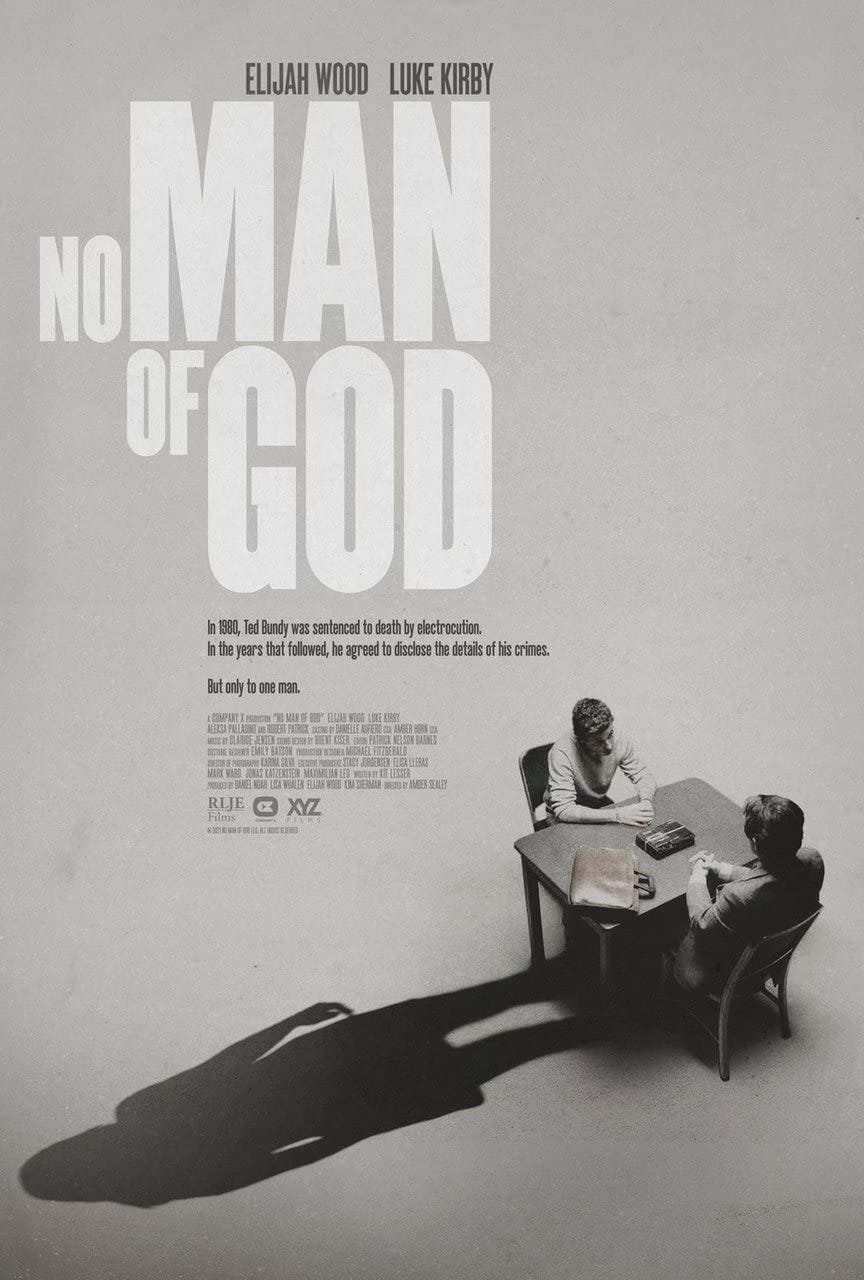
The poster for the film is probably one of the cleverest pieces of marketing graphics I’ve seen in a long time. It came out around the time of Covid Lockdowns so it had to work much harder to connect with potential audiences and not get lost in the white noise of digital marketing. It’s a masterpiece in visual problem-solving and storytelling. It does not flatter Bundy - lets us know what the film is about and tells us what to expect before we start, if we bother to look.
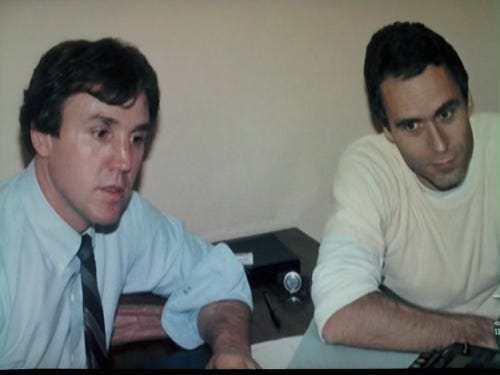
The Real Heigmaier (left) with Bundy
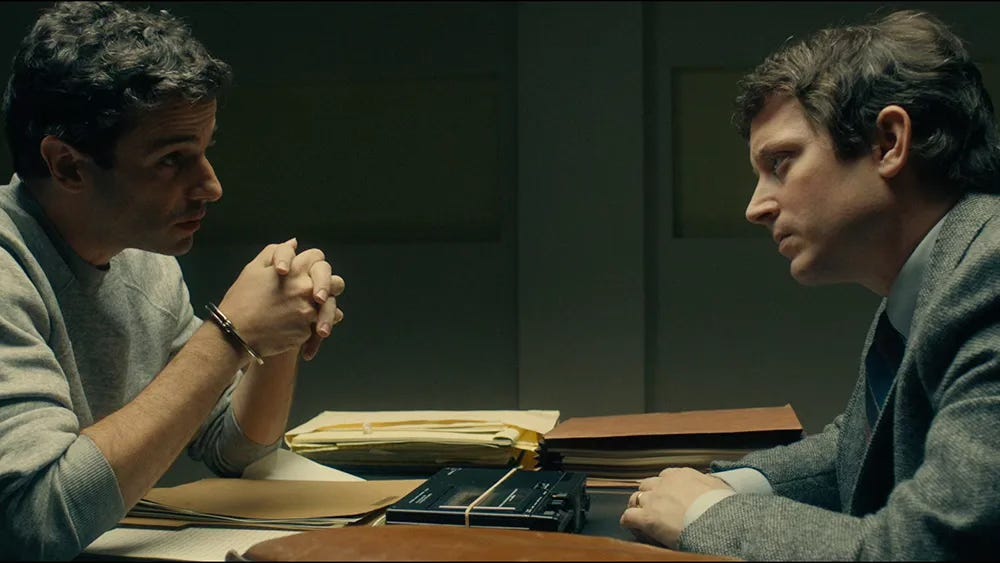
Elijah Wood (Right) as Hagmeier and Luke Kirby as Bundy
The visual space is quartered up into sections. Text, image, void and shadow - setting up a visual dynamic and sense of conflict and competition. The blocky, newsy, dynamic typography of the title emphasises 2 words - MAN and GOD, once again suggesting both partnership and conflict with a line drawn visually down the centre of the page - two halves, good and bad - man and god. There are two men (again, one is man - one is God, but each has different ideas as to which one they might be), their poses are the same but they could not be more different - one boxed into the corner (Bundy was in a high-security prison with no chance of freedom) and one facing him, with the space behind him to escape - this is Hagmeier - he can leave whenever he wants, Bundy cannot, Hagmeier is higher on the page (in Heaven) Bundy is lower (in Hell). We don’t see Bundy’s face, this is intentional, he exploited his good looks to kill women, and we’ve denied him that power. The men are at a small table, they are metaphorically playing chess, there is more than one power struggle between them (Bundy is attempting to have his death sentence commuted) On the table is a tape recorder, Bundy needs to get his voice out there to gain support - Hagmeier needs his voice to analyse Bundy’s psychosis so that he can understand, identify and stop men like him. Most important is the shadow of a woman drawn away from the table, cast by the two men but dividing them - not a stylised, sexualised female shape that we would expect on a movie poster - but an ordinary woman, she could be shopping or waiting for a bus - she’s all women, everywhere, who have to live in the shadow of men like Bundy. Both these men have women in their lives and both need to look at them again as real people before the movie ends, and not as just shadows. Women are the important characters in this film, but most have no dialogue, we don’t need to hear them speak to know what they have to go through - it’s written on their faces, besides, men like Bundy (and in some respect, as he eventually realises, men like Hagmeier) don’t listen anyway.
Solving problems with serial killers
I always tell clients that the only way to solve a design problem is to first understand what it is, and then work out what it isn’t.
By coincidence, there is another line in ‘Silence’ that echos this -
“First principles, Clarice. Simplicity. Read Marcus Aurelius. Of each particular thing ask: what is it in itself? What is its nature? What does he do, this man you seek?”
Everything is trying to tell us its story - and as designers, we provide the visual language it needs to speak. We read far more from images than we realise - our brains compare everything we see with everything we have ever seen and look for correlations, contrasts and conflicts - but you can’t solve a problem without really understanding what the solution needs to be, and why.
I work with so many people who just want things to look good (although not usually serial killers) - and that’s fine, but it’s wallpaper. I can’t work unless I do it properly, sometimes you can just ‘get’ a brief and the solution reveals itself but most of the time you have to put in the work - and think it through. When I was teaching I’d remind students that as the design industry gets more superficial, AI-assisted and streamlined by technology, they have a greater responsibility to learn how to do things properly - and position themselves to be the only person in the room who really knows what they are doing and how to do it.